Soil Temp for Germ 45–85°F
Seed Depth ¼"
Seed Spacing 4 per in.
Days to Emergence 6–21
Thin Plants to 1–3"
Row Spacing 9–16"
Fertilizer Needs Low
Minimum Germination 75%
Seeds per Gram ≈ 650–750
Seed Life 3 years
1501 E First Ave Anchorage, AK 99501
Registering provides you with personalized services, including: wish list, order status and promotions.
Register
Daucus carota var. sativus Studies on the nutritional properties of carrots have revealed that they are powerhouses of a wide range of phytonutrient antioxidants. With the vast spectrum of colors and varieties available, the amounts of individual antioxidants vary, yet the overall balance of these potent nutrients contributes to outstanding health benefits regardless of the variety.
Days to maturity are calculated from date of direct seeding.
Culture
• Carrots perform best in deeply worked, well-composted, loose soil with a pH of 6.0-7.0
• When the soil is workable, spade or till it to a fine texture 12-16 inches deep — cloddy, heavy soil will not make straight roots
• Heavy soils can cause forked roots; use Chantenay, Kuroda, Paris Market, or Nantes types in heavy soils
• Avoid split roots by maintaining even watering
• When plants have 7-10 leaves, hill 1-2 inches of soil around crowns to prevent green shoulders
Direct Sowing
• Dig a shallow furrow and lightly cover seed with soil, vermiculite or sifted compost
• Water evenly and regularly to prevent soil crusting
• Row cover beds when soil temperatures are cool and to help prevent soil crusting
• Thin when plants are 4 inches tall
• Sow mid-June—July for a fall/winter crop
Insects & Diseases
• Common insects: Carrot fly
• Insect control: Row covers at planting
• Common diseases: Various blights
• Disease prevention: 3-4 year crop rotation
Harvest & Storage
• Best harvested when 1/2-3/4 inches in diameter when carrots are sweet and tender
• Irrigate well prior to harvest to ensure the roots have absorbed their maximum capacity of water
• Cut tops prior to storage
• Store at 36°F and 95% relative humidity
• Fall/Winter Crop: Flavor is enhanced after a couple of frosts
• Fall/Winter Crop: Roots can be dug any time at maturity through winter as needed
• Fall/Winter Crop: In harsh climates, mulch with straw for protection
What is pelleted seed?
Seed that has been coated with a clay-based material to form a larger, round shape. This makes planting by hand or mechanical seeder easier and allows for more controlled sowing of small seeds such as carrots or lettuce. All pelleted seed has a National Organic Program (NOP) approved coating.
KEY TO CARROT DISEASE RESISTANCE AND TOLERANCE
HR indicates high resistance.
IR indicates intermediate resistance.
AB | Early (Alternaria) Blight
Ad | Alternaria dauci - "Alternaria Leaf Blight"
Ar | Alternaria radicina - "Black Rot"
AS | Alternaria Stem Canker
C | Cercospora
CS | Cavity Spot
MA | Liquorice Rot
P | Pythium Root Rot
PM | Powdery Mildew
Territorial Seed Company
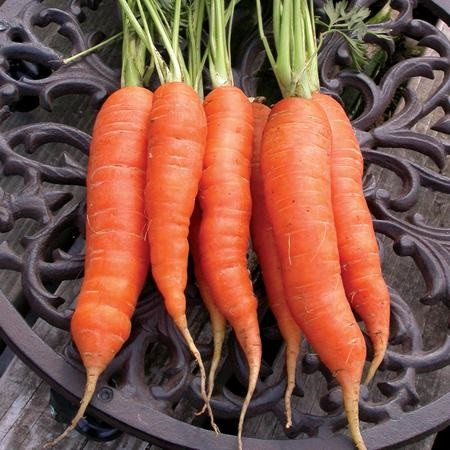
After one bite of this sweet carrot it is easy to see why we fell in love with Romance. Bright, glowing orange roots are prime for eating when approximately 6 inches long. Tall, strong tops make...
Territorial Seed Company
The uniform, 6–8 inch long, slightly tapered roots are sweet and crunchy, prime qualities for snacking. A bright orange Nantes variety, Bolero grows to 1 ½ inches across and is adorned with a 10...
Territorial Seed Company
Super tasty and nutritious, Sugarsnax 54 is sweet and tender for superior eating quality. Rich, dark orange color reveals the extra high beta-carotene content. Slender roots grow 9 inches...
Territorial Seed Company
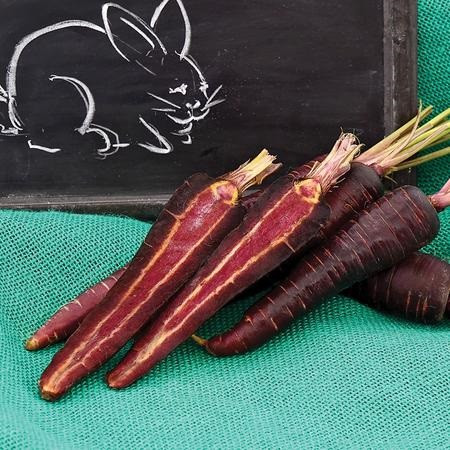
We've searched worldwide for a great tasting, true red carrot, and finally found it! Its bold, sweet flavor synchronizes flawlessly with the crisp, bright, rosy flesh. Red Samurai adds panache to...
Territorial Seed Company
Whether harvested as a baby carrot or grown to its full length of 8 inches, Purple Sun fits the bill. Unlike other purple carrots, it has a strikingly strong purple color from skin to core. The...